
UNODC, Rizq and Yunus Centre at AIT Launch Social Enterprise Development Leadership Program
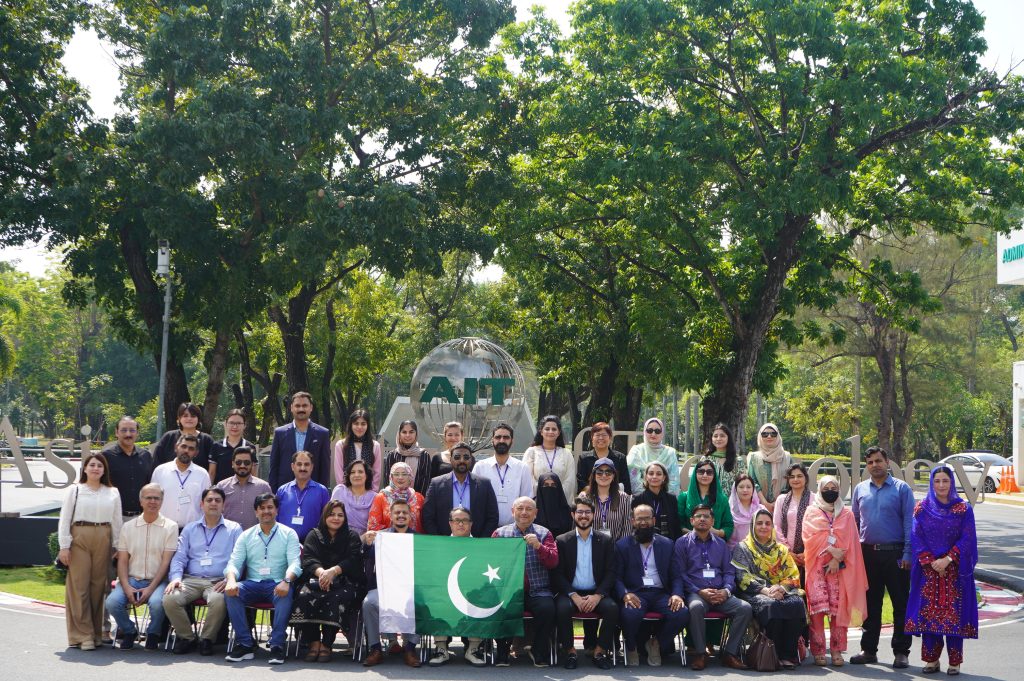
In a first-of-its-kind initiative for Pakistan, the United Nations Office on Drugs and Crime (UNODC), Rizq, and the Yunus Centre at Asian Institute of Technology (AIT) have jointly conducted a national Social Enterprise Development Leadership Program for faculty from Pakistan’s public sector universities. The program represents a significant step toward institutionalizing social enterprise education in Pakistan’s higher education system, positioning enterprise-led development as a tool for peacebuilding and social impact.
The customized program brought together 26 faculty members from 19 public sector universities across Pakistan, representing a wide range of academic disciplines. Designed to strengthen institutional capacity, the initiative aimed to equip educators with conceptual frameworks, practical tools, and international exposure to catalyze social enterprise development within their universities and beyond. The program was delivered through an 11-day immersive learning module at the Asian Institute of Technology, Thailand, held from 15 to 26 January 2026. The module combined expert-led academic sessions, applied learning workshops, field visits to leading social business models, and faculty-led project presentations.
As part of the experiential learning component, participants visited several social business ventures in Thailand. These included visits to the following social business ventures: STEP cafe – empowering neurodivergent young people, Stingless Bee Honey Coop – sustaining livelihoods by selling, processing, and offering education on nutrient-rich honey and related products, as well as Wat Chak Daeng – transforming plastic waste to useful materials. During the program, the participants also had the chance to visit the Population and Community Development Association (PDA) and Embassy of Pakistan in Thailand.
The three organizing partners bring complementary strengths to the initiative. UNODC, a global leader in prevention-led development, emphasized the role of social enterprise in creating productive opportunities for youth and addressing structural vulnerabilities.
Prof. Hussain Haider, Senior Legal Expert at UNODC Pakistan, while speaking at session during the program said, “UNODC has long viewed youth as central to addressing complex social challenges. Engaging with faculty members from across Pakistan is a powerful reflection of this vision in practice. Initiatives like these support peacebuilding efforts by fostering compassion, innovation, and responsible leadership among future generations.”
Rizq, Pakistan’s pioneering social enterprise, has over a decade of experience designing and scaling impact-driven models aligned with the Sustainable Development Goals, particularly SDG 2: Zero Hunger. Through its work with universities, policymakers, and global institutions, Rizq is leading national efforts to embed social enterprise within academic and policy frameworks.
“Hosting faculty from across Pakistan was both an honour and a responsibility for Rizq,” said Musa Aamir, Co-founder of Rizq. “The country has tremendous potential in social entrepreneurship, and UNODC’s leadership in this initiative is a vital step toward preparing future generations to tackle social challenges through enterprise-driven approaches”.
The Yunus Centre at AIT, the first such centre established in a university, serves as a global hub for advancing Nobel Laureate Dr. Muhammad Yunus’ social business philosophy through education, research, and practice, making it the ideal place for the faculty to gain real exposure regarding the global social business landscape.
“In the next 20 years, with the efforts of people like yourselves, you will see more young people having a choice – between becoming a hard-hitting businessman, or becoming a mission-driven social business leader. This program is the first step in laying the foundation for future social leaders.” said Prof. Faiz H. Shah, Executive Director, YCA said during the closing session.
Beyond capacity building, the program facilitated cross-cultural exchange between Thai social business practitioners and Pakistani academics. The collaboration has laid the groundwork for a future roadmap that includes curriculum integration, faculty-led social innovation initiatives, and the potential establishment of social enterprise incubation hubs within participating universities, with UNODC working to further expand the academic network.
The participating public universities belonged to all provinces of Pakistan for increased diversity and reach of the learning. This included The Begum Nusrat Bhutto Women University, Bahauddin Zakariya University, Kohat University of Science & Technology, FATA University, University of Narowal, University of Balochistan, Gomal University, Sardar Bahadur Khan Women’s University, BUITEMS, Lasbela University of Agriculture, Water and Marine Sciences, National University of Modern Languages Islamabad (NUML), Sukkur IBA University, University of Sargodha, Shah Abdul Latif University, Sardar Bahadur Khan Women’s University, Karakoram International University, University of Swat, University of Karachi, University of Turbat, Shah Abdul Latif University and the University of Azad Jammu Kashmir.
Reflecting on the journey, Qasim Javaid, CEO of Rizq, remarked that witnessing Pakistani faculty engage with global social business models reaffirmed the country’s strong potential in the field. He noted that the initiative marks an important step toward building a sustainable and locally rooted social entrepreneurship ecosystem in Pakistan.
Join this mission: https://rizq.org/our-partners/
You Might Also Like
 2 mins read
February 3, 2026 • Relief and Resilience
World Central Kitchen partners with Rizq for flood relief activities in Punjab
Read More 2 mins read
February 3, 2026 • Relief and Resilience
Bringing Hope to the Valley That Gives Us Life: Relief Activities in Swat
Read More 2 mins read